





During an AFSCA inspection, the hand wash basin is one of the very first pieces of equipment the inspector checks. Missing, badly positioned, without soap or fitted with a hand-operated tap? That is an immediate non-conformity — and one of the most common in Belgian restaurants. Yet the rules are clear and the investment is modest.
In this article you will find the precise regulatory framework, the technical characteristics of a compliant hand wash basin, the essential accessories, the mistakes that trigger non-conformities and a buying guide to equip your kitchen at the best value for money.
Why is a hand wash basin compulsory in a professional kitchen?
A dedicated hand wash basin is compulsory because hands are the leading source of food contamination in catering: 25 % of foodborne illnesses are directly linked to poor hand hygiene among staff. A compliant hand wash basin is therefore a critical control point (CCP) in the HACCP system.
European Regulation EC 852/2004 (known as the "Hygiene Package") requires every business handling foodstuffs to have a sufficient number of basins for washing hands. These basins must be separate from those used for washing food or dishes, and must be supplied with hot and cold water, soap and a hygienic drying device.
In Belgium this obligation is reinforced by the HORECA sector self-checking guide (AFSCA guide G-023), which sets out the installation and equipment conditions. Failing to meet it constitutes a major non-conformity during an AFSCA inspection, and can lead to a warning, an official report or a fine.
The difference between a hand wash basin and a sink
This distinction is fundamental and a frequent source of confusion:
- The hand wash basin is exclusively for staff hand washing. It must be used for nothing else: no dishes, no rinsing vegetables, no filling containers.
- The pot wash sink is for washing dishes and utensils.
- The preparation sink is for washing fruit, vegetables and food.
These three functions cannot be served by a single water point. If your kitchen has only one sink, you are non-compliant — even if you "only use it for hands".
The 6 characteristics of a HACCP-compliant hand wash basin
A hand wash basin compliant with HACCP standards must meet six mandatory characteristics, which the AFSCA inspector checks systematically during every food safety inspection. The absence of any one of them is enough to trigger a non-conformity.
1. Non-manual operation
This is the most important requirement and the one most often breached. The water control must not be operable by hand, in order to avoid recontamination after washing. Compliant systems are:
- Knee operation: a bar or lever operated with the knee (the most common solution in catering)
- Foot operation: a floor pedal
- Automatic detection: an infrared sensor that starts the water as the hands approach (the premium solution)
- Elbow operation: a long lever that can be operated with the forearm
The Tournus GC professional hand wash basin available from GL Distribution is a model designed specifically for professional catering. In stainless steel with a splashback, it is fitted with a hot/cold water pre-mixer with non-return valves and a swan-neck spout with aerator. Its design with an upstand protects the wall from damp and splashes.
2. Mixed hot and cold water
The hand wash basin must deliver water at a lukewarm temperature (around 35-40 °C) for effective washing. A pre-mixer set to the right temperature avoids scalding and makes washing comfortable, which encourages staff to wash their hands frequently.
3. The bactericidal soap dispenser
A soap dispenser must be installed immediately next to the hand wash basin. The soap must be bactericidal (effective against common bacteria) and held in a refillable dispenser — not a bar of soap left on the edge, which is a source of cross-contamination.
A 1L professional soap dispenser mounted on the wall is the most hygienic solution. It refills easily and delivers a measured dose of soap each time it is used.
4. Disposable hand towels
Hands must be dried with single-use (paper) hand towels in food production areas. Reusable cloths are prohibited because they quickly become vectors of contamination. Warm-air hand dryers may be accepted in changing rooms and toilets, but not directly in the preparation area (risk of dispersing micro-organisms).
The Bulkysoft zigzag folded hand towels in the 21×24 cm, 2-ply format are the standard for professional washroom dispensers. They fit into a wall dispenser that guarantees hygienic sheet-by-sheet delivery.
5. The pedal bin
Next to the hand wash basin, a bin with non-manual opening (pedal or automatic) is needed so that used hand towels can be discarded without touching the lid and recontaminating the hands.
6. The washing protocol on display
A poster describing the hand washing steps (wet, soap, scrub for 30 seconds, rinse, dry) must be placed above or beside the hand wash basin. This signage acts as a permanent reminder for staff and demonstrates your commitment to hygiene during an inspection.
Key point: Hand sanitiser gel does not replace hand washing. It can supplement washing, but it does not remove visible soiling or food residues. Washing with water and bactericidal soap remains the reference method in a professional kitchen.
Where should you install the hand wash basin in your kitchen?
The location of the hand wash basin matters as much as its equipment: it must be easily reachable from every workstation, without obstacles, to encourage staff to use it systematically. A badly placed hand wash basin is an unused hand wash basin.
The required locations
The principle is simple: staff must be able to wash their hands without crossing the whole kitchen. In practice that means:
- A hand wash basin in every food handling area (cold preparation area, cooking area, plating area)
- A hand wash basin at the kitchen entrance for systematic washing before starting work
- A hand wash basin next to the staff toilets
The number of hand wash basins depends on the size of your kitchen and how many people work there at the same time. For a small kitchen with 2-3 cooks, one well-placed basin may be enough. For a brigade of 5 or more, two basins minimum are recommended.
The most common placement mistakes
- Putting the hand wash basin behind a door or in a corner that is hard to reach
- Installing the hand wash basin too far from the preparation stations (staff "forget" to use it)
- Blocking access to the hand wash basin with equipment or stock
- Installing the hand wash basin only in the bin store or the changing room
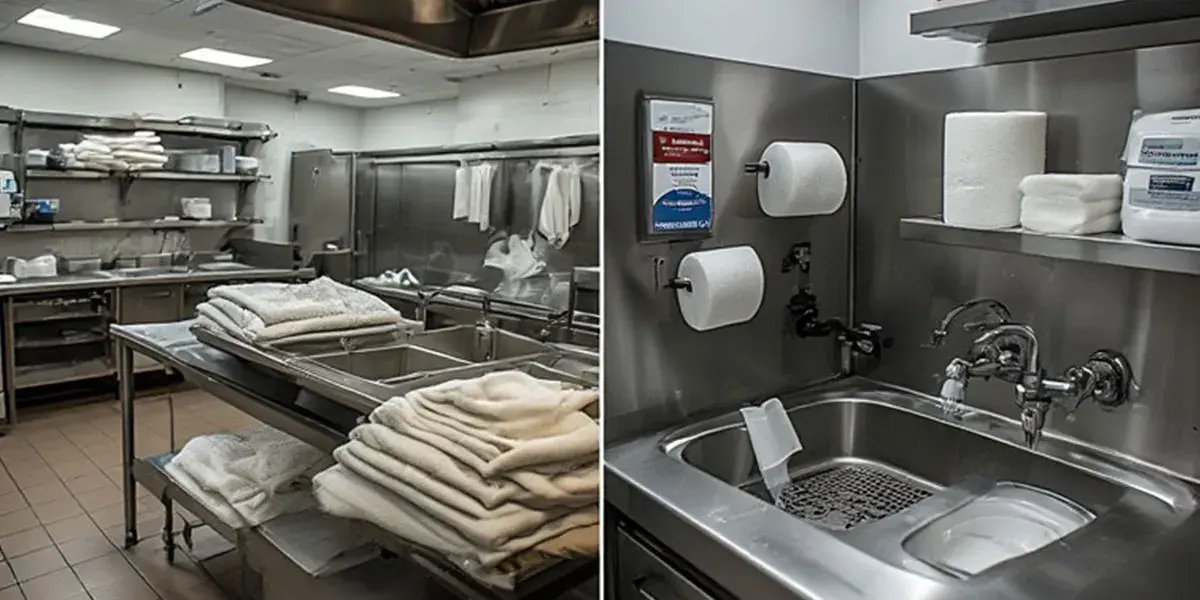
When to wash your hands: the HACCP critical moments
The HACCP system identifies "critical moments" when hand washing is compulsory in order to prevent any contamination. These moments must be known to all staff and observed without exception.
Hand washing is compulsory in the following situations:
- On arriving in the kitchen, before starting work
- After going to the toilet
- After blowing your nose, coughing or sneezing
- After handling waste (bins, packaging boxes)
- After handling raw meat, fish or eggs and before moving on to another food
- After touching your face, hair or phone
- After handling cleaning products or cleaning chemicals
- Between each change of task (moving from raw preparation to cooking, for example)
Wearing nitrile gloves does not remove the need to wash your hands. Gloves must be put on clean hands and changed at every change of task, exactly like a hand wash.
AFSCA inspection checklist: what is checked on the hand wash basin
During a food safety inspection, the AFSCA inspector systematically checks all of the following points regarding the hand wash basin(s) in your kitchen. Use this checklist to audit yourself regularly.
|
Control point |
Compliant |
Non-compliant |
|
Dedicated hand wash basin (separate from the pot wash sink) |
✅ Present and identified |
❌ Absent or confused with the sink |
|
Non-manual operation |
✅ Knee, foot or sensor |
❌ Hand-operated tap |
|
Hot and cold water |
✅ Lukewarm water available |
❌ Cold water only |
|
Bactericidal soap dispenser |
✅ Stocked and working |
❌ Empty, absent or soap not bactericidal |
|
Disposable hand towels |
✅ Dispenser filled |
❌ Cloth, empty, or air dryer in the production area |
|
Pedal bin |
✅ Present nearby |
❌ Absent or manually opened |
|
Washing protocol displayed |
✅ Visible and legible |
❌ Absent or illegible |
|
Accessibility |
✅ Free and direct access |
❌ Blocked by equipment |
|
Cleanliness |
✅ Clean, no deposits |
❌ Dirty, limescale, mould |
|
Working order |
✅ Water runs, drain clear |
❌ Leak, blockage, malfunction |
Which hand wash basin to choose: the selection criteria
Choosing a professional hand wash basin comes down to four criteria: the material, the dimensions, the type of control and how easy it is to clean. Here are the key points for making the right investment.
The material: stainless steel, the only professional choice
Stainless steel is the reference material in a professional kitchen. It resists corrosion, cleaning products and knocks, and it cleans easily. A stainless steel hand wash basin lasts for decades without deteriorating. Ceramic or plastic models are not suited to a professional kitchen environment.
The Tournus GC hand wash basin is made from food-grade stainless steel. Its rectangular bowl of 345 × 245 mm offers a comfortable washing volume, while its compact overall dimensions (440 × 335 mm, height 540 mm with the splashback) allow it to be installed even in small kitchens.
The dimensions: compact but practical
A hand wash basin that is too small discourages use (splashing, hands touching the sides). A bowl of at least 300 × 200 mm is recommended for comfortable washing. The splashback is a major asset: it protects the wall from damp and makes cleaning easier.
The price: a modest investment
A professional stainless steel hand wash basin with non-manual operation costs between 150 and 400 € depending on the model and the type of control. That is a very modest investment compared with the consequences of a non-conformity (fine, temporary closure, loss of reputation). Add a soap dispenser (30-60 €) and a hand towel dispenser (40-80 €) for a complete washing station.
Frequently asked questions about the HACCP hand wash basin
Is a hand wash basin compulsory in every professional kitchen? Yes, every business handling foodstuffs — restaurant, chip shop, bakery, caterer, food truck, snack bar — must have at least one hand wash basin dedicated to hand washing, separate from any pot wash or preparation sink. This obligation comes from European Regulation EC 852/2004, which applies in every country of the European Union.
Is an ordinary tap accepted on a HACCP hand wash basin? No. The regulations require non-manual operation to prevent recontamination of the hands after washing. Accepted systems are knee, foot or elbow operation, or automatic detection (infrared sensor). A tap with a handle or a turning knob is a non-conformity.
How many hand wash basins do you need in a restaurant kitchen? The number depends on the size of the kitchen and how many people work there at the same time. For a small kitchen (2-3 people), one well-placed basin may be enough. For a brigade of 5 or more, two basins minimum are recommended. The key principle: every handling station must have a hand wash basin reachable without crossing the whole kitchen.
Can hand sanitiser gel replace hand washing? No. Sanitiser gel does not remove visible soiling or food residues. It can be used in addition to washing, but never instead of it. Washing with lukewarm water and bactericidal soap for at least 30 seconds remains the only compliant method in a professional kitchen.
Are cloths allowed for drying hands? No, not in food production areas. Single-use (paper) hand towels are compulsory in areas where foodstuffs are handled. Reusable cloths are vectors of cross-contamination. Warm-air hand dryers may be accepted in changing rooms and toilets, but not directly in the kitchen area.
What is the risk if the hand wash basin is not compliant during an AFSCA inspection? The absence of a compliant hand wash basin is a major non-conformity during an AFSCA inspection. Sanctions range from a warning to an official report, with an obligation to put things right within a short deadline (15 working days). In the event of a serious or repeated failing, temporary closure of the business may be ordered. The result of the inspection is published on Foodweb, which consumers can access.
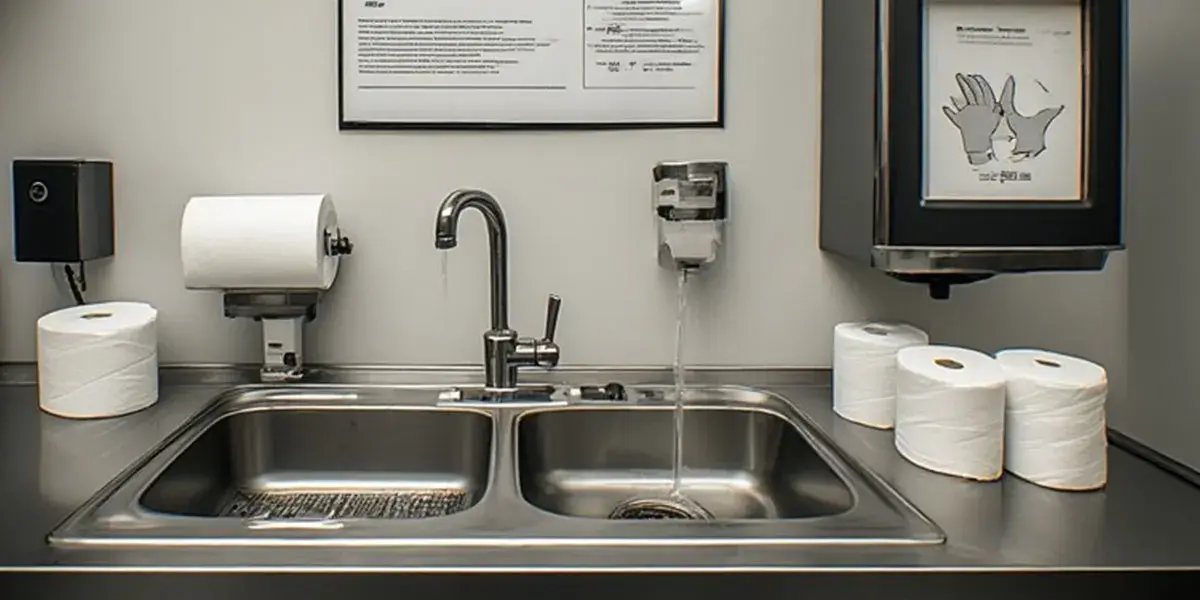
Equip your kitchen with a compliant hand wash basin
The hand wash basin is the simplest, cheapest and most effective investment in your HACCP compliance. For a few hundred euros, you eliminate one of the leading causes of non-conformity during AFSCA inspections and you concretely protect your customers' health.
GL Distribution supplies the Tournus GC stainless steel professional hand wash basin, together with soap dispensers, Bulkysoft zigzag hand towels and professional hygiene products. We also offer professional nitrile gloves to complete your hygiene equipment. All our products are available from permanent stock with delivery within 48 hours in Belgium and Luxembourg.
Need advice on equipping your kitchen? Call our HORECA advisers on +32 (0) 495 41 41 59 or browse our online shop.
Recommended products
To go further, discover our professional selection: