





During an AFSCA inspection, the inspector always asks for the cleaning and disinfection schedule (PND). Not a vague timetable pinned to the wall, but a structured document that answers five questions precisely: what to clean, when, how, with which product and by whom. The absence of this document, or an incomplete one, is one of the most common non-conformities in catering — and one of the easiest to put right.
The HACCP cleaning schedule is a compulsory document that sets out the frequency, the method, the products and the people responsible for cleaning and disinfecting every area, surface and piece of equipment in your professional kitchen. It forms part of the good hygiene practices (GHP) required by European Regulation EC 852/2004 and is an essential prerequisite of the HACCP system.
What is a HACCP cleaning schedule and why is it compulsory?
The cleaning and disinfection schedule (PND) is a written document, compulsory for every professional kitchen, which formalises all the cleaning operations to be carried out, their frequency, their method and the staff responsible. Without this document, your HACCP self-checking system is considered incomplete.
The PND follows a simple logic: improvised cleaning is incomplete cleaning. Without a written plan, some areas are cleaned too often (wasted time) while others are forgotten (a health risk). The schedule guarantees that every surface, every piece of equipment and every area gets the attention it needs, at the right frequency, with the right product and the right method.
During an AFSCA inspection, the inspector checks three things related to cleaning: the existence of the PND (the document), proof that it is applied (the signed record sheets) and the actual state of cleanliness of the premises and equipment (visual observation). A PND that is perfect on paper but not applied is just as problematic as no PND at all.
The 5 columns of the cleaning schedule: the required structure
A cleaning schedule that meets HACCP requirements rests on five columns answering the questions: What? When? How? With what? By whom? This structure guarantees that every piece of information staff and inspectors need is available.
Column 1 — WHAT? (Area and item)
List every area of your kitchen and, for each area, every item to be cleaned. Organise by area to make follow-up easier:
- Cooking area: ranges, ovens, fryers, griddles, extraction hoods, filters, walls behind the equipment
- Storage area: refrigerated cabinets, shelving, cold rooms, floors, doors
- Wash-up area: sinks, drainers, dishwasher, walls, floors
- Service area: pass, display cabinets, counters
- Toilets and changing rooms: WCs, wash basins, hand wash basins, floors, mirrors
- Waste: bins, bin store, containers
Column 2 — WHEN? (Frequency)
The frequency depends on the level of risk and on usage. Here are the frequencies recommended by the good hygiene practice guides:
|
Frequency |
Items concerned |
|
After each use |
Work surfaces, chopping boards, utensils, hand wash basins |
|
After each service |
Ranges, griddles, fryers (outside), kitchen floors, pass |
|
Daily (end of day) |
Complete floors, doors, handles, bins, extraction hoods (outside) |
|
Weekly |
Kitchen walls, fridges (inside), hoods and filters, traps |
|
Monthly |
Freezers (if static cooling), dishwasher (descaling), ceilings |
|
Quarterly |
Ventilation, grease ducts, fridge seals, lighting |
|
Annually |
Complete walls, ceilings, paintwork, extraction ducting |
Column 3 — HOW? (Method)
Describe the cleaning method step by step for each item. This is where the TACT method comes in — the four factors of effective cleaning (detailed in the next section).
Column 4 — WITH WHAT? (Product and equipment)
State the exact product to use (trade name, dilution, contact time) and the equipment (sponge, brush, microfibre cloth, squeegee). The professional cleaning products must comply with food safety standards, and their technical and safety data sheets must be kept in an accessible folder.
For wiping and drying surfaces, single-use paper is preferable to a reusable cloth, which redeposits micro-organisms from one area to another: the centrefeed wiping roll is used once and eliminates that risk of cross-contamination. Also provide paper hand towels at the hand washing station, which is compulsory in handling areas.
Column 5 — BY WHOM? (Responsible person)
Name a role rather than a person (staff change): closing chef, kitchen porter, service commis, and so on. This column guarantees that no task ends up being "nobody's job".
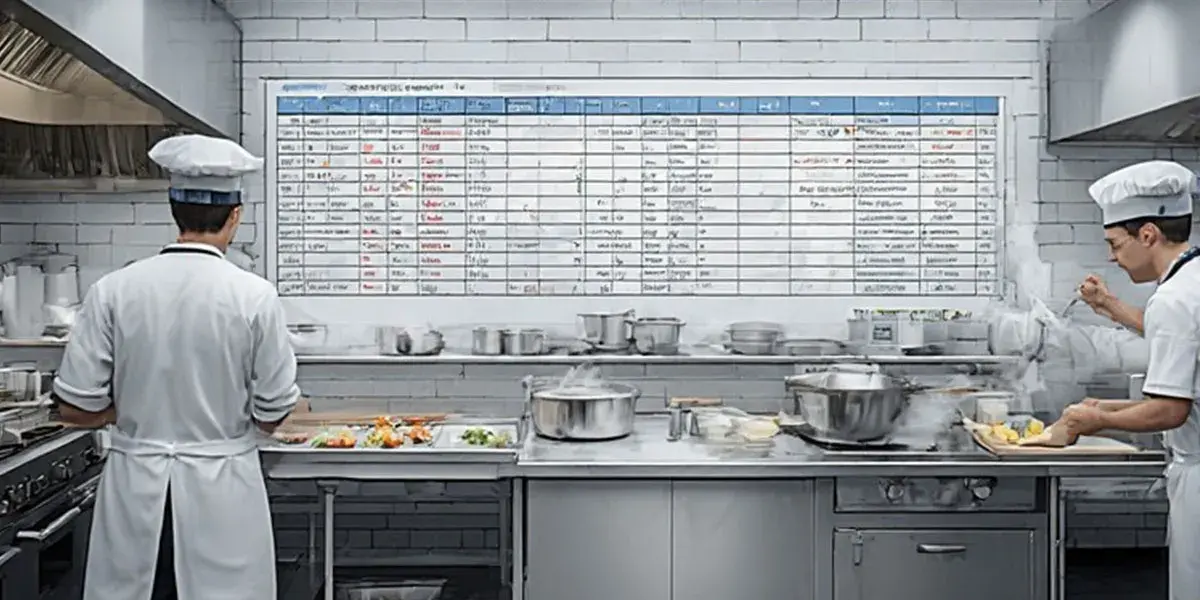
The TACT method: the 4 factors of effective cleaning
The TACT method is the reference protocol in professional food hygiene. It rests on the balance of four factors: Temperature, mechanical Action, chemical Concentration and contact Time. If one of these factors is insufficient, cleaning is ineffective even if the other three are respected.
T — Temperature
Hot water dissolves fats and activates the active ingredients in detergents. The recommended temperature for cleaning in the kitchen is 45 to 55 °C for washing and 60 to 85 °C for thermal disinfection (professional dishwasher). Careful: water that is too hot (> 60 °C) in manual washing risks "cooking" food proteins onto the surfaces, making them harder to remove.
A — mechanical Action
Physical rubbing lifts soiling off the surface. It is the factor most often neglected: pouring a product onto a surface without scrubbing does not clean it. Mechanical action can be manual (sponge, brush, cloth) or mechanical (dishwasher, pressure washer).
C — chemical Concentration
The dose of cleaning product must follow the manufacturer's recommendations. Too little product = ineffective cleaning. Too much product = chemical residues on surfaces and extra cost. The exact dilution is given on the product's technical data sheet. Use a measuring device rather than guesswork.
T — contact Time
Every product has a minimum action time to be effective. A degreaser sprayed on and wiped off immediately does not degrease. A disinfectant must stay in contact with the surface for the prescribed time (often 5 to 15 minutes) before rinsing. This contact time is given on the product's technical data sheet.
Key point: If you reduce one of the TACT factors, you must compensate by increasing another. For example, with cold water (low T), you must scrub for longer (high A) or use a more concentrated product (high C). It is a balance, not a fixed recipe.
The right product for each surface: the practical guide
Using the wrong product on the wrong surface is a common mistake that can damage your equipment, leave toxic residues or simply fail to clean. Here is the surface-to-product guide for a professional kitchen.
|
Surface |
Recommended product |
What not to use |
|
Stainless steel work surfaces |
Multi-purpose degreaser + food-safe disinfectant |
Abrasive sponge (scratches stainless steel), neat bleach |
|
Ranges and griddles |
Heavy-duty degreaser (caustic type), with gloves |
Acidic product on stainless steel |
|
Ovens |
Oven degreaser, or pyrolysis if fitted |
Metal scourer on the glass |
|
Fryers |
Alkaline degreaser made for fryers |
Cold water on hot oil |
|
Kitchen floors |
Neutral detergent or floor degreaser |
Neat ammonia (too volatile) |
|
Refrigerated cabinets |
Neutral detergent + food-safe disinfectant |
Concentrated bleach (attacks the seals) |
|
Hand wash basins |
Detergent + disinfectant, rinse thoroughly |
Scouring cream (scratches the bowl) |
|
Toilets |
Detergent + virucidal disinfectant |
Bleach + ammonia mixture (toxic!) |
|
Chopping boards |
Dishwasher at 85 °C, or food-safe disinfectant |
Prolonged neat bleach (yellows HDPE) |
The GL Distribution range of cleaning products covers the essential needs of a professional kitchen: V201 multi-purpose degreaser (5L), neat ammonia (5L), bleach (3×5L), Tana scouring cream and industrial drain unblocker. All are formulated for intensive use in a HORECA environment.
Golden safety rule: never mix ammonia and bleach. That mixture produces chlorine gas, a toxic gas that can cause serious respiratory irritation. It is the most common cleaning accident in professional kitchens.
Record sheets: the proof that the schedule is applied
A cleaning schedule on paper is not enough: you must prove that it is actually applied day to day, through record sheets signed by staff. These sheets are the first document the AFSCA inspector asks for after the PND itself.
What the record sheet must contain
A simple, effective record sheet includes:
- The date and time of the cleaning operation
- The area and the item cleaned
- The name or initials of the person who carried out the cleaning
- A tick box or initials confirming it was done
- A space to note any anomalies (missing product, faulty equipment, damaged surface)
Paper or digital format?
The classic paper format (a laminated sheet displayed in each area, with a table to initial) is still the most widespread. It has the advantage of simplicity and requires no technology investment. On the other hand, it can be lost, falsified or illegible.
The digital format (an app on a tablet or smartphone) is gaining ground. It offers automatic time-stamping, an instantly searchable history and alerts when a task is missed. It is the 2026 trend recommended by the AFSCA as part of its digital transformation.
How long to keep records
Keep your record sheets for at least one year. In mass catering, some regulations require them to be kept for 3 years. During an AFSCA inspection, the inspector may ask for the history of the last few months — a well-kept file is your best ally, just as it is for your fridge temperature records.

The 5 cleaning mistakes that trigger non-conformities
Certain mistakes come up systematically during AFSCA inspections and could be avoided with a properly applied cleaning schedule. Here are the five most common traps.
Mistake 1: no written PND. The cleaning schedule must be a physical document (paper or digital), not an oral habit. The inspector asks to see it and to read it. Without a written document, it is an immediate non-conformity, even if your kitchen is spotless.
Mistake 2: a generic PND not adapted to your kitchen. A template downloaded from the internet and never personalised will not do. Your PND must reflect the real areas of your kitchen, your real equipment and the products you actually use. The inspector checks that the document matches the reality on the ground.
Mistake 3: no technical data sheets for the products. For every cleaning product used, you must keep the technical data sheet (instructions, dilution, contact time) and the safety data sheet (SDS) supplied by the manufacturer. These documents must be filed somewhere accessible.
Mistake 4: storing cleaning products with foodstuffs. Chemicals must be stored in a separate cupboard or room, closed and labelled, inaccessible from the food production area. A bottle of bleach standing next to the tinned goods is a serious non-conformity.
Mistake 5: not disinfecting after cleaning. Cleaning ≠ disinfecting. Cleaning removes visible soiling. Disinfection removes invisible micro-organisms. Both steps are necessary and must be done in this order: clean first (detergent), then disinfect (food-safe disinfectant), then rinse.
Expert tip: Ask your cleaning product supplier to give you a pre-filled PND matched to their products. Good suppliers offer this free of charge — it saves you time and makes sure you use the right dilutions and contact times for each product.
Frequently asked questions about the HACCP cleaning schedule
Is a cleaning schedule compulsory for every restaurant? Yes, the cleaning and disinfection schedule (PND) is compulsory for every professional kitchen, whatever its size. It forms part of the good hygiene practices (GHP) required by European Regulation EC 852/2004 and is a prerequisite of the HACCP system. A restaurant without a written PND is non-compliant during an AFSCA inspection.
How often should a professional oven be cleaned? A professional oven must be cleaned after every service (outside, and inside if soiled) and given a deep clean weekly (heavy-duty degreaser or a pyrolysis cycle if fitted). Racks and trays must be washed in the dishwasher after each use.
Can bleach be used to disinfect everything in the kitchen? Diluted bleach is an effective and inexpensive disinfectant, but it is not suitable for every surface. It can attack fridge door seals, corrode some metals and yellow plastics with prolonged use. For stainless steel, prefer a neutral food-safe disinfectant. And never mix bleach with ammonia.
How do you organise cleaning between two services? Between lunch and dinner service, concentrate on the surfaces in direct contact with food: work surfaces, chopping boards, utensils, the pass. Floors can be swept, but a full clean can wait until the end of the last service. The hand wash basin must be restocked with soap and hand towels between each service.
How long should cleaning record sheets be kept? Keep your record sheets for at least one year. In mass catering, the recommended period is 3 years for verification and audit documents. The AFSCA inspector may ask for the history of the last few months during an inspection. A chronological binder or a digital system makes quick consultation easier.
What is the TACT method? TACT is the acronym for the four factors of effective cleaning: Temperature (hot water), mechanical Action (scrubbing), chemical Concentration (product dosage) and contact Time (how long the product acts). If one factor is insufficient, it must be compensated by another. It is the reference protocol in professional food hygiene.
Bring your cleaning schedule into compliance
A well-structured HACCP cleaning schedule is one of the simplest and most rewarding investments for your restaurant. It protects your customers, reassures the AFSCA inspector, extends the life of your equipment and raises the professionalism of your team. Start by listing your areas and equipment, assign the frequencies, choose the right products and train your staff.
To equip your kitchen with HACCP-compliant professional cleaning products, GL Distribution offers a complete range: V201 multi-purpose degreaser, neat ammonia 5L, bleach 3×5L, scouring cream, industrial drain unblocker, blue wiping rolls and professional hand towels. Permanent stock, delivery within 48 hours in Belgium and Luxembourg.
Need advice on the right products for your kitchen? Call our HORECA advisers on +32 (0) 495 41 41 59 or browse our online shop.
Recommended products
To go further, discover our professional selection:
Cleaning consumables: